What Minnesota’s DataMaster DMT can miss, and what Knapp requires the government to prove.
Minnesota’s DataMaster DMT does not reject every breath sample that shows signs of mouth alcohol contamination. It applies specific rejection rules. A falling alcohol reading can escape those rules without a warning.
The legal standard requires more. In Knapp v. Commissioner of Public Safety, decided November 12, 2026, the Minnesota Supreme Court held that the Commissioner must prove, by a preponderance of the evidence, that the challenged breath sample was not contaminated. That means more likely than not.
The DMT’s threshold for flagging a sample does not set the amount of contamination a court must tolerate.
The manufacturer’s warning about falling alcohol readings
Mouth alcohol can falsely elevate a breath test result. Alcohol remaining in the mouth, or introduced by regurgitation or reflux, can contribute to a reading intended to measure alcohol in deep lung breath.
The original manufacturer’s DataMaster DMT Owner’s Guide describes how the alcohol concentration should rise during a continuous exhalation, then become more uniform. On page 22, it states:
“Under no circumstances, should this reading ever decline during any continuous exhalation.”
A decrease is called a negative slope. It raises a question about the sample, although the shape of the curve alone does not establish what caused it.
The same guide also describes specific software conditions that trigger rejection. Its broad explanation of a proper breath sample and its programmed rejection rules are two different things.
Why a suspicious sample may not trigger INVALID
The Minnesota Bureau of Criminal Apprehension’s DMT Operator Training Manual spells out the rejection criteria.
One rule requires three consecutive decreases in the quarter-second averages, each greater than 0.001 g/210 L, after at least six positive comparisons within the same continuous breath sample. A decline that does not follow that sequence or exceed that threshold may escape this rule.
Another rule compares the final reading with an earlier high. When the final quarter-second average is at least 0.060 g/210 L, it triggers INVALID if it falls below 95% of a previous high during that successfully delivered sample. The manual provides a separate rule for lower final readings.
These are rules about the size, timing, and sequence of changes. They do not establish that every other declining pattern is harmless.
When the government relies on the absence of an INVALID warning, the defense should examine exactly what that warning system was capable of detecting.
What the breath profile shows
Consider the profile and worksheet excerpt below.
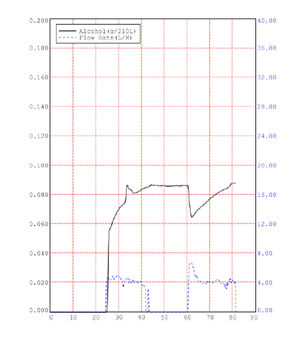
During the interval shown in the worksheet, the recorded alcohol concentration fell from approximately 0.08663 to 0.08113 g/210 L, a decline of about 6.35%. Across twelve successive comparisons, nine readings decreased and three remained unchanged. None increased. Recorded breath flow remained above 2.87 liters per minute, the BCA’s minimum, during that interval.
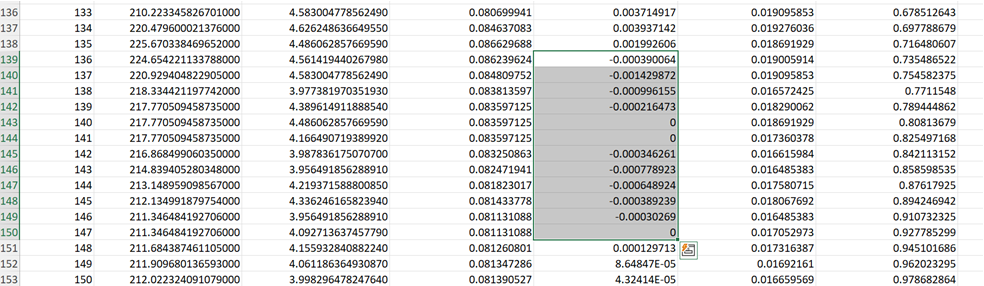
According to the account accompanying this example, the machine did not issue an INVALID warning.
The decline occurred during an earlier blowing attempt. It does not, by itself, establish contamination of the later accepted sample. Nor does an intermediate drop of more than 5% automatically satisfy a rule that compares the final reading with an earlier high.
But the decline needs an explanation. Looking only at the reported result would miss the sequence that raises the question.
Published research has found gaps in mouth alcohol detection
In his 2025 paper, The limitations of mouth alcohol detection systems in breath alcohol testing, forensic toxicologist Aaron Olson described three cases strongly suggesting that mouth alcohol contamination escaped detection.
In 2026, Olson and I published Same pattern, different result: Algorithmic inconsistency in breath alcohol testing. We examined four selected cases that met the stated 95% rejection criterion. The instrument generated an INVALID message in one. It did not generate that message in the other three.
Those four cases do not establish a failure rate for all DMT tests. They document discrepancies that the published criteria did not explain, and they support independent examination of how the software applies those criteria.
The BCA’s training exercise does not answer that question. In the exercise, students swish alcohol in their mouths, provide a breath sample, and observe an INVALID message. That demonstrates that the instrument can detect the contamination produced in that exercise. It does not measure how often contaminated samples escape detection.
A witness who saw that demonstration still needs a basis for concluding that the machine would have detected the contamination at issue in a particular case.
What Knapp requires the court to examine
Knapp arose from a civil license revocation proceeding involving an allegedly inadequate observation period.
The Supreme Court rejected automatic answers on either side. An imperfect observation period does not automatically exclude the result. The driver’s failure to produce direct affirmative evidence of mouth alcohol does not automatically make the result admissible. The court must consider all evidence bearing on contamination.
That approach requires a closer look at an unflagged test. The instrument’s messages belong in the record alongside the breath profile, observation evidence, and testimony explaining what the detection system can and cannot establish.
The Supreme Court did not evaluate the separate profile reproduced in this article. Its decision supplies the framework for examining such evidence.
Reviewing a Minnesota breath test means obtaining the underlying data
For defense counsel, the practical work starts with the complete testing record. Obtain the breath profile and underlying data, identify each blowing attempt, and compare the instrument’s messages with the applicable detection rules. Review the observation evidence, including available video, for events that could have introduced mouth alcohol.
Keep the questions separate. Did the software apply its documented rules? Could those rules miss the contamination under investigation? Does the full record establish that the sample was uncontaminated?
An answer to the first question does not dispose of the other two.
For someone facing a Minnesota DWI charge or license revocation, this is a reason to have the underlying breath data reviewed before deciding what the reported number proves.
Contact Ramsay Law Firm about a disputed breath test or an attorney referral. We represent drivers and work with referring counsel on cases involving disputed breath test evidence.
Ramsay Law Firm represented the National College for DUI Defense as amicus curiae in Knapp.
Read the Knapp series
- Part 1: What the Minnesota Supreme Court changed in Knapp
- Part 2: How mouth alcohol contamination can raise a Minnesota DWI breath test result
Sources
- Knapp v. Commissioner of Public Safety, No. A24-1440, slip op. at 30–33 (Minn. Nov. 12, 2026). Counsel listing at p. 1.
- National Patent Analytical Systems, DataMaster DMT Owner’s Guide, rev. Aug. 9, 2008, pp. 21–22.
- Minnesota Bureau of Criminal Apprehension, DMT Operator Training Manual, v.4.2, Nov. 14, 2025, pp. 21–22 (acceptance criteria), 48 (observation), 58 (INVALID criteria), and 83 (training exercise).
- Aaron Olson, The limitations of mouth alcohol detection systems in breath alcohol testing: Case reports, Forensic Science International: Synergy 10 (2025), 100573. DOI: 10.1016/j.fsisyn.2025.100573.
- Aaron Olson and Charles Ramsay, Same pattern, different result: Algorithmic inconsistency in breath alcohol testing-case reports, Forensic Science International: Synergy 12 (2026), 100689. DOI: 10.1016/j.fsisyn.2026.100689.
- Supplied DMT breath profile and worksheet excerpt, rows 138–150. The worksheet supports the numerical comparison; the reported absence of an INVALID warning comes from the accompanying account.